
Google Ads Budget for Small Business: How Much Should You Spend in 2026?
Running Google Ads can help a small business reach people who are already searching for its products or services. But one question comes up again and again:
How much should a small business spend on Google Ads?
There is no single budget that works for every business. A local service business, ecommerce store, consultant, restaurant, and B2B company can all need very different budgets.
The right Google Ads budget for a small business depends on factors such as your industry, location, keywords, competition, average customer value, conversion rate, and target cost per lead.
For many small businesses, it is better to start with a controlled test budget, measure the results, and increase spending when the campaign produces profitable leads or sales.
In this guide, we will explain how to calculate a Google Ads budget, how much you can start with, what affects your costs, and how to avoid wasting your advertising money.
Table of Contents
- How Much Should a Small Business Spend on Google Ads?
- What Is a Good Google Ads Budget for a Small Business?
- Google Ads Daily Budget vs Monthly Budget
- How to Calculate Your Google Ads Budget
- Example of a Google Ads Budget
- What Determines Google Ads Cost?
- How Much Does a Google Ads Lead Cost?
- Should You Start With a Small or Large Budget?
- How to Reduce Wasted Google Ads Spend
- Why Conversion Tracking Is Important
- When Should You Increase Your Google Ads Budget?
- Google Ads Budget for Local Businesses in Delhi NCR
- Common Google Ads Budget Mistakes
- Frequently Asked Questions
- Final Thoughts
How Much Should a Small Business Spend on Google Ads?
A small business can start Google Ads with a budget that matches its goals and cash flow.
For example, a business might test Google Ads with:
| Monthly Budget | Approx. Daily Budget | Suitable For |
|---|---|---|
| ₹9,000 | ₹300/day | Small initial test |
| ₹15,000 | ₹500/day | Local lead generation |
| ₹30,000 | ₹1,000/day | Established campaigns |
| ₹60,000 | ₹2,000/day | More competitive markets |
| ₹1,00,000+ | ₹3,300+/day | Aggressive growth |
These are starting examples, not fixed industry prices.
A ₹15,000 monthly budget may be enough for a small local service in a low-competition market. However, the same amount may be too small for a highly competitive industry where clicks are expensive.
Google itself describes an average daily budget as the amount you are roughly comfortable spending per day over the course of a month.
The important question is therefore not:
“What is the cheapest Google Ads budget?”
Instead, ask:
“What budget gives my business enough data to generate profitable conversions?”
What Is a Good Google Ads Budget for a Small Business?
For many small businesses, a practical starting point is ₹300–₹1,000 per day for a focused campaign.
That means approximately:
- ₹9,000/month at ₹300/day
- ₹15,000/month at ₹500/day
- ₹30,000/month at ₹1,000/day
However, your ideal budget depends on your target customers and keywords.
For example, suppose you run a local AC repair company.
If your average customer is worth ₹5,000 and you can make ₹2,000 profit from a new customer, paying ₹500 for a qualified lead might be reasonable.
But if you sell a ₹500 product with a ₹100 profit, the same advertising cost could be difficult to sustain.
This is why your customer value and profit margin should influence your Google Ads budget.
Google Ads Daily Budget vs Monthly Budget
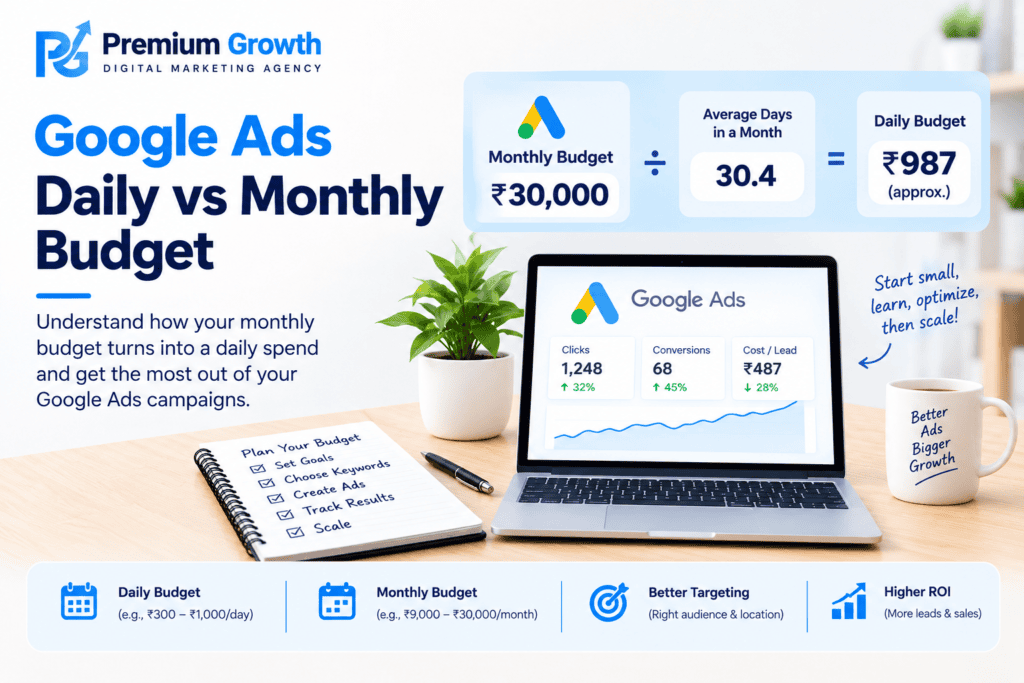
Google Ads uses an average daily budget for campaigns.
If you want to spend approximately ₹30,000 per month, you can calculate the average daily budget by dividing your monthly budget by 30.4.
₹30,000 ÷ 30.4 ≈ ₹987/day
Google explains that monthly spending is generally based on the average daily budget multiplied by 30.4. On some days, actual spending can be higher than the average daily budget, while the monthly charging limit still applies.
So don’t panic if your campaign does not spend exactly the same amount every day.
Google may adjust spending based on expected traffic and conversion opportunities.
How to Calculate Your Google Ads Budget
One of the best ways to calculate a Google Ads budget for a small business is to work backward from your sales goal.
Use this simple process.
Step 1: Decide How Many Customers You Need
Suppose your business wants:
20 new customers per month.
Step 2: Estimate Your Lead-to-Customer Rate
Let’s say:
- 100 leads
- 20 become customers
Your lead-to-customer rate is:
20%
Step 3: Calculate Required Leads
If you want 20 customers:
20 ÷ 20% = 100 leads
You need approximately 100 leads.
Step 4: Estimate Your Target Cost Per Lead
Suppose your target CPL is ₹500.
Then:
100 leads × ₹500 = ₹50,000
Your estimated monthly Google Ads budget would be ₹50,000.
This is much more useful than choosing a random advertising budget.
Example of a Google Ads Budget
Let’s take a local digital marketing agency as an example.
Suppose the business wants:
- 30 leads/month
- Target CPL: ₹500
- Lead-to-client rate: 20%
The estimated advertising requirement is:
30 × ₹500 = ₹15,000/month
If 20% of those leads become clients:
30 leads × 20% = 6 clients
If the average client generates ₹20,000 in revenue, the potential revenue is:
6 × ₹20,000 = ₹1,20,000
This does not mean every campaign will generate exactly these numbers.
Actual performance depends on keyword competition, landing page quality, ad relevance, conversion rate, sales follow-up, location targeting, and many other factors.
But this framework helps you create a data-driven PPC budget.
What Determines Google Ads Cost?
Your Google Ads cost for a small business can change significantly based on several factors.
1. Keyword Competition
Competitive keywords usually attract more advertisers.
For example, keywords related to:
- Lawyers
- Insurance
- Loans
- Real estate
- Digital marketing
- Home services
can be competitive in some locations.
More competition can increase the amount advertisers are willing to pay for clicks.
2. Location
Your location also matters.
Running Google Ads in a small city may have different competition from targeting a large metropolitan market.
If you target Delhi NCR, your campaign can become more competitive because you are targeting a large and valuable customer market.
This is why location-specific keyword research is important.
3. Search Intent
Not every keyword has the same value.
Consider these searches:
“What is digital marketing?”
and
“digital marketing agency near me”
The second search usually shows stronger commercial intent.
Your budget should prioritize keywords that are more likely to generate customers.
4. Landing Page Quality
Getting clicks is not enough.
Suppose you spend ₹10,000 and receive 100 visitors.
If your landing page is confusing and only one person contacts you, your campaign may struggle.
A clear landing page should have:
- Strong headline
- Relevant offer
- Clear benefits
- Trust signals
- Testimonials
- Simple contact form
- Phone/WhatsApp CTA
- Fast loading speed
- Mobile-friendly design
How Much Does a Google Ads Lead Cost?
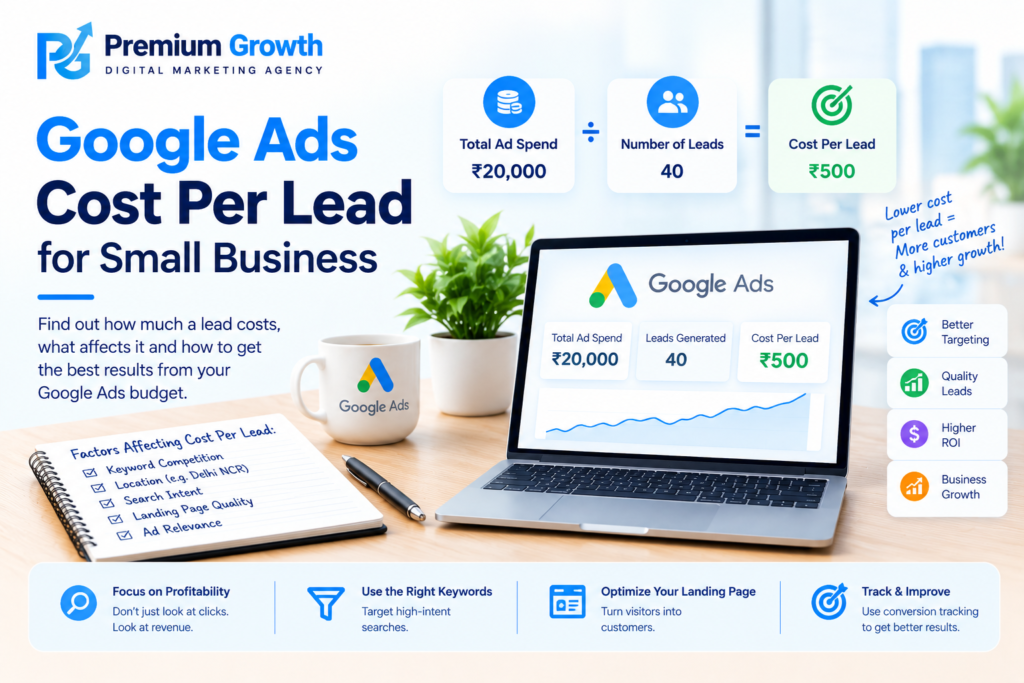
There is no universal Google Ads cost per lead.
Your cost per lead depends on:
CPL = Total Ad Spend ÷ Number of Leads
For example:
₹20,000 ad spend ÷ 40 leads = ₹500 CPL
Another business might spend ₹20,000 and generate only 10 leads.
Its CPL would be:
₹20,000 ÷ 10 = ₹2,000 CPL
That does not automatically mean the second campaign is bad.
If one ₹2,000 lead becomes a customer worth ₹50,000, the campaign may still be highly profitable.
So don’t judge Google Ads only by clicks or CPL.
Look at revenue and profit.
Should You Start With a Small or Large Budget?
For a new campaign, starting with a controlled budget is usually sensible.
For example:
Testing Stage
₹300–₹500/day
Use this stage to learn:
- Which keywords generate clicks
- Which search terms generate leads
- Which ads perform best
- Which locations perform well
- Which landing pages convert
Optimization Stage
Once you have useful conversion data, remove waste and focus more budget on successful campaigns.
Scaling Stage
If your campaign produces profitable conversions, gradually increase your budget.
Google also provides budget and planning tools that can help advertisers estimate how budget changes may affect campaign performance.
How to Reduce Wasted Google Ads Spend
A small business cannot afford to waste its advertising budget.
Here are some practical ways to improve your Google Ads budget for small business.
Use Specific Keywords
Avoid targeting every keyword related to your business.
Focus on searches that have genuine commercial intent.
For example, a local web design company could target:
“web design company Delhi”
instead of spending heavily on a broad term such as:
“website.”
Use Negative Keywords
Negative keywords help prevent ads from appearing for unwanted searches.
For example, a company selling professional services may want to exclude searches such as:
- Free
- Jobs
- Course
- Tutorial
- Salary
- Internship
The exact negative keyword list should depend on your business.
Target the Right Locations
If you serve Delhi NCR, don’t automatically advertise across all of India.
Target the areas where you can actually serve customers.
You can build separate campaigns or location groups for areas such as:
- Delhi
- Noida
- Gurgaon
- Ghaziabad
- Faridabad
depending on your service area.
Improve Your Ad Copy
Your ad should match what people are searching for.
For example:
Digital Marketing Agency in Delhi NCR
can be more relevant for someone searching for a local digital marketing agency than a generic advertisement.
Why Conversion Tracking Is Important
One of the biggest mistakes small businesses make is measuring only clicks.
Clicks don’t pay your bills.
Customers do.
Google Ads conversion tracking can measure valuable actions such as purchases, sign-ups, phone calls, and other customer actions.
You can also track website button clicks, such as a phone number or “Buy Now” button, as conversions.
For website campaigns, Google recommends using the Google tag and relevant event snippets to measure conversions.
For a lead-generation business, you may want to track:
- Contact form submissions
- Phone calls
- WhatsApp clicks
- Quote requests
- Appointment bookings
- Purchases
Once conversion tracking is working, you can make decisions based on cost per lead, conversion rate and return on ad spend instead of guessing.
When Should You Increase Your Google Ads Budget?
Don’t increase your budget simply because your campaign is receiving clicks.
Consider increasing your Google Ads daily budget when:
- You are receiving qualified leads
- Your conversion tracking works correctly
- Your cost per lead is acceptable
- Your sales team can handle more leads
- Your landing page converts well
- Your campaigns are limited by budget
- Your customers are profitable
Google notes that if a campaign is limited by budget but generating conversions at a reasonable CPA, increasing the budget can help capture additional demand.
A good approach is to scale gradually instead of doubling the budget without analyzing performance.
Google Ads Budget for Local Businesses in Delhi NCR
For local businesses in Delhi NCR, Google Ads can be useful because people often search for services when they are ready to take action.
For example:
- “dentist near me”
- “digital marketing agency Delhi”
- “AC repair Gurgaon”
- “web designer Noida”
- “interior designer Delhi”
- “CA near me”
A local business should not simply ask:
“How much should I spend?”
It should ask:
“How many profitable customers do I need, and how much can I afford to pay to acquire each customer?”
For a small local business, you could start by testing a focused campaign with ₹300–₹1,000 per day, then adjust based on actual conversion data.
For highly competitive services, you may need a larger budget to collect enough data and compete for valuable searches.
Common Google Ads Budget Mistakes
Mistake 1: Choosing a Budget Without a Goal
Don’t choose ₹10,000 simply because it sounds affordable.
Set a target first.
For example:
Goal → 20 qualified leads/month
Then calculate your required budget.
Mistake 2: Looking Only at CPC
A low CPC does not always mean a good campaign.
You could get cheap clicks that never become customers.
A slightly higher CPC can be acceptable if those clicks produce better leads.
Mistake 3: Sending Traffic to the Homepage
Your ad should ideally send users to a relevant landing page.
If someone searches for Google Ads services, don’t send them to an unrelated page.
Send them to a page specifically about the service.
Mistake 4: Not Tracking Calls and Forms
If your campaign generates phone calls but you don’t track them, you may think the campaign is performing poorly.
Conversion tracking gives you a clearer picture of what your ads are actually producing.
Mistake 5: Increasing the Budget Too Quickly
More budget does not automatically mean more profit.
Fix targeting, keywords, ads, landing pages and tracking first.
Then scale.
Frequently Asked Questions
How much should a small business spend on Google Ads per month?
A small business can test Google Ads with around ₹9,000–₹30,000 per month, depending on its market and goals. Competitive industries may require more.
Is ₹500 per day enough for Google Ads?
₹500 per day can be a reasonable starting point for some local businesses. However, whether it is enough depends on keyword CPC, competition, location and conversion rate.
What is a good Google Ads budget for a local business?
For many local businesses, ₹300–₹1,000 per day can be used as an initial testing range. The right budget should ultimately be based on profitable conversions.
How much does Google Ads cost per lead?
There is no fixed cost per lead. Calculate it using:
Total Google Ads spend ÷ Number of qualified leads
Can I start Google Ads with ₹10,000?
Yes. A ₹10,000 budget can be used for an initial campaign test. However, the campaign should be tightly targeted so the budget is not spread across too many keywords, locations or campaigns.
Should I spend more on Google Ads or SEO?
Google Ads can generate paid traffic quickly, while SEO can build organic visibility over time. Many businesses benefit from using both.
If you’re comparing the two strategies, read our guide on Google Ads vs SEO for Local Businesses.
Final Thoughts: How Much Should a Small Business Spend on Google Ads?
There is no magic number for a Google Ads budget for small business.
A good budget should be connected to your:
- Customer value
- Profit margin
- Target leads
- Conversion rate
- Cost per lead
- Keyword competition
- Location
- Sales capacity
For a small local business, starting around ₹300–₹1,000 per day can be a practical testing range. But the right amount depends on your specific business.
The goal should not be to spend the most money.
The goal is to spend enough to generate profitable customers and then scale what works.
If your campaigns are generating qualified leads at an acceptable cost, increase the budget gradually. If you’re getting clicks but no customers, fix your targeting, ads, landing page and conversion tracking before spending more.
If you need help creating and managing Google Ads campaigns for your business in Delhi NCR, Premium Growth can help you build a conversion-focused PPC strategy.
Want to turn your Google Ads budget into measurable growth? Contact Premium Growth today.
